

Overview
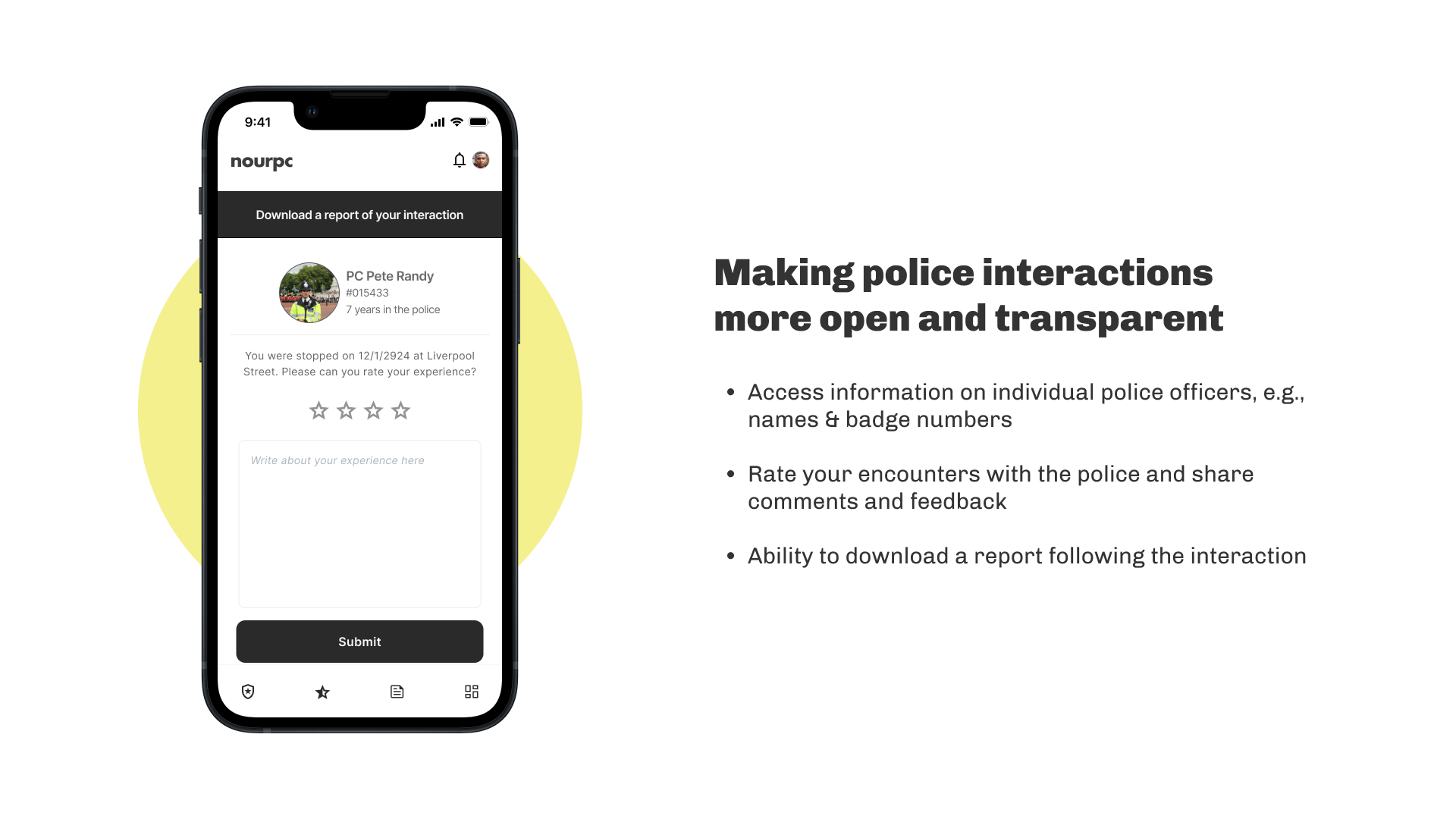
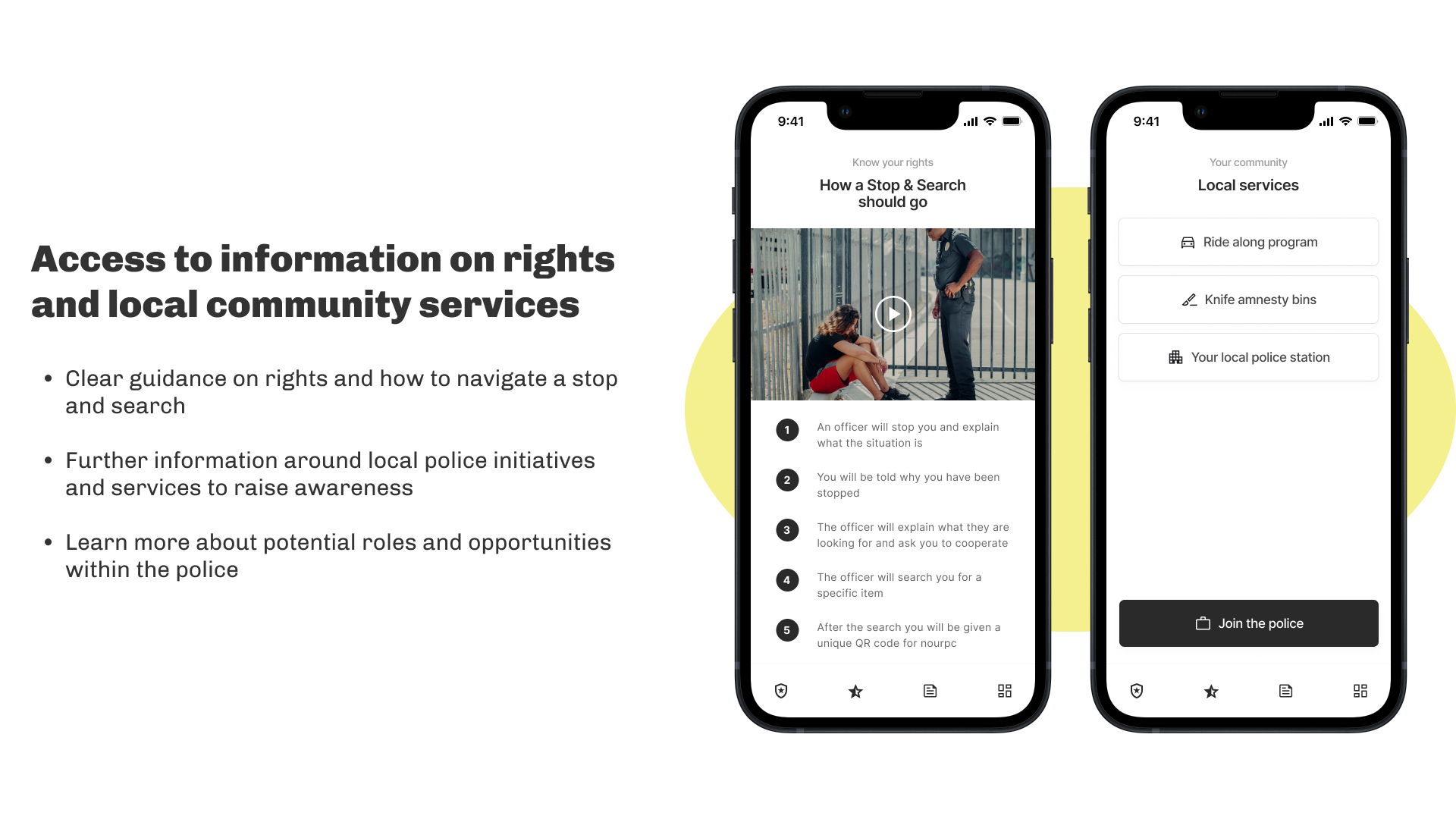
NoUrPC helps young people view details on police officers during interactions and access guidance on their rights and local services.
The project came out of a collaborative initiative sponsored by Amazon Web Services. It brought together Experience Haus alumni designers, City of London Police, Metropolitan Police and 50 students aged 16 to 21. The objective was to co-design a digital platform that could improve the relationship between young people and police in London.
My role
User research, storyboarding guidance, UI design (working alongside 2 designers, 5 students and 1 youth mentor)
Methods
User interviews · Affinity mapping · Storyboarding · Low-fi wireframing · Prototyping
Tools
Figma · Google Slides · Whiteboard · Pen + paper
The problem
Young people in London distrust the police, and the data supports why.
The relationship is shaped by fear, frustration and a sense of powerlessness. Stop and search falls disproportionately on young people and Black communities, and most interactions feel one-directional. There was no tool giving young people transparency, context or agency in those moments.
The solution
NoUrPC increases transparency and gives young people a sense of connection during police interactions.

Background
The project ran across two one-day sessions. The first, in September 2022, generated a series of early concepts. Designers and participants reconvened in February 2024 at Amazon HQ to develop those concepts into presentable MVPs, with police officers and industry experts providing input throughout and ensuring viability and alignment with realistic goals.
User research
We interviewed all five students to understand how they felt about policing in their communities.
The questions were designed to surface emotions, personal experiences and ideas for change.
01 — Emotion
What kind of emotions do you feel when interacting with police?
02 — Trust
Do you feel comfortable reaching out to them when you need assistance?
03 — Experience
Tell us about a specific encounter you've had with the police.
04 — Transparency
Have you ever been stopped and searched?
05 — Perception
How would you describe police attitudes toward local youth?
06 — Change
How could the police realistically improve their relationship with you?
The tone was honest. A few students acknowledged police as helpful in some situations, but the overwhelming picture was one of distrust, frustration and a feeling of being targeted.
Key insights
Five students. Four clear themes.
| Theme | User Insight |
|---|---|
| Transparency Gap | Students felt a total lack of confidence in knowing their rights during stop-and-search interactions. |
| Perceived Bias | A strong feeling of being targeted specifically due to age and racial profiling, leading to unease. |
| Power Imbalance | Intimidation and vulnerability came up repeatedly, driven by power imbalances and a perceived lack of accountability. |
| Desire for Connection | Despite everything, there was a clear openness to constructive dialogue and better engagement. |


desk research
The students' experiences map onto well-documented patterns.
stop and searches per 1,000 Black people — compared with 5.6 per 1,000 white people in England and Wales.
gov.uk · April 2021 – March 2022
of all stop and searches were carried out on people aged 10 to 24.
stop-watch.org · Year ending March 2021
How might we?
How might we promote transparency and facilitate more positive interactions between young people and the police, to build mutual trust and understanding?
Ideation
In ideation, four key concepts emerged.
Students collaborated directly with police officers and industry experts to shape the product's core features.
| Feature | Description |
|---|---|
| QR Code Integration | Strategic placement on officer badges and in local areas to provide instant access to officer profiles and community-specific police information. |
| Officer Rating System | Allows users to rate interactions and escalate concerns, feeding into a database reviewed regularly by police. |
| Resource Hub | A dedicated space for information on individual rights, stop-and-search guidance, and awareness of positive initiatives like the Ride Along programme and knife amnesty bins. |
| Youth-Centric Branding | Co-designed and named 'NoUrPC' (Know Your Police Constable) by the students themselves to ensure the tool feels authentic and accessible to their peers. |
storyboarding
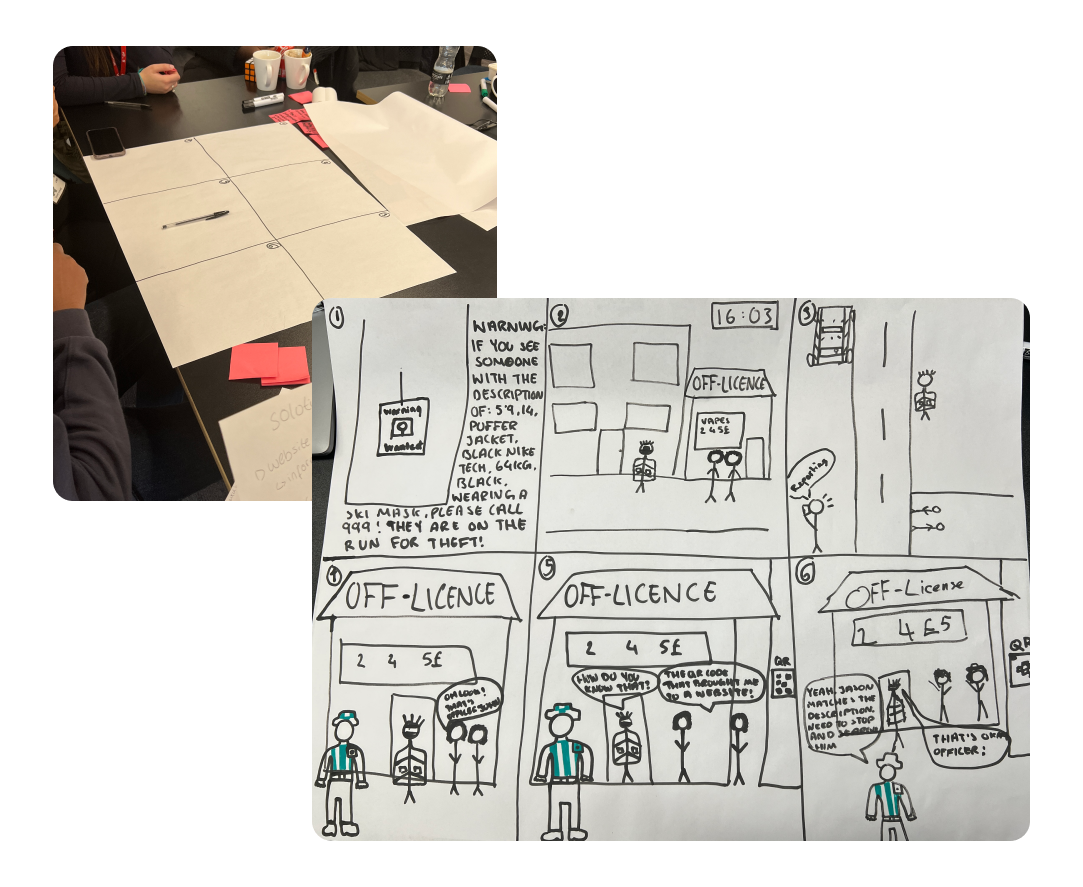
We guided the students through creating a storyboard to map out how someone would actually use the product. They led the process, and watching them exchange ideas and build on each other's thinking was one of the highlights of the day.
Design
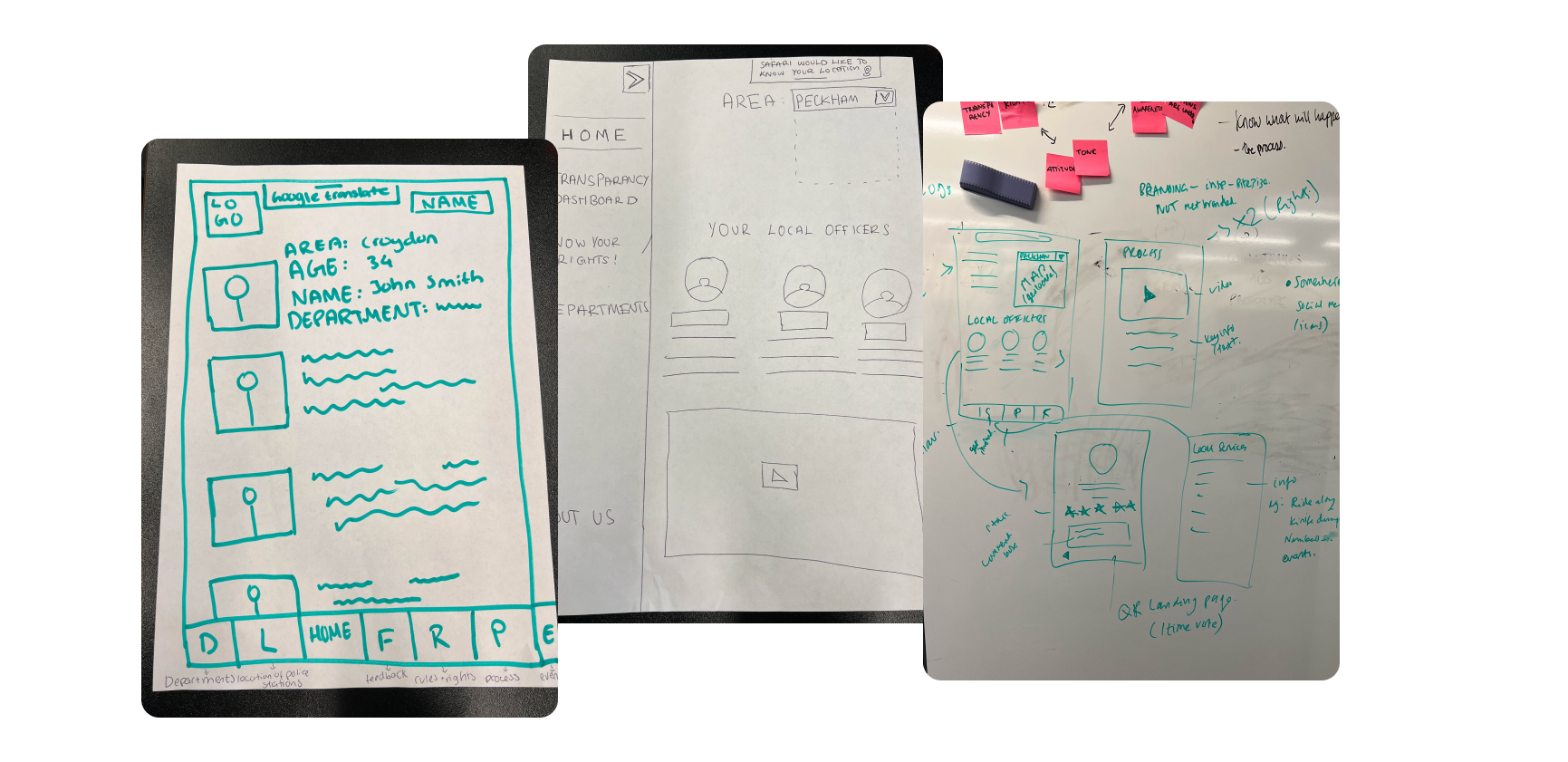
Low-fidelity wireframes.
Students sketched wireframes on paper and whiteboard to visualise core screens and flows before anything went digital.
The final MVP.
We translated the concepts into high-fidelity wireframes and a working prototype, then compiled findings, process and designs into a presentation for the wider group.

Next steps
The concepts were taken forward for iteration and further development, with police planning to incorporate elements from each team's designs. Check out these videos to see how both days went:
Day 1
Day 2
Reflections
What I learned, and what I'd do differently.
Co-design changes the work. The students shaped every major feature. Giving them real ownership over ideation and storyboarding meant the product reflected their actual needs, not assumptions made on their behalf. It also made the collaboration richer and more honest.
Designing for trust means understanding both sides. Officers shared that they often feel defined by their uniform before their humanity. Hearing that reframed some of my own assumptions and reminded me that designing for trust means understanding both sides of the relationship.
One round of testing wasn't enough. The hackathon format meant we moved from concept to prototype quickly, which was energising, but we never tested the designs with users outside the room. A follow-up round of testing with a broader group of young people would have revealed whether the product actually delivered on the transparency and connection it promised.
Good intentions need measurable outcomes. We designed for transparency and trust, but we didn't define what success would actually look like in practice. If I returned to this, I'd establish clear metrics, whether that's interaction ratings, engagement with the resource hub, or shifts in sentiment over time.
Onsee: An end-to-end design process for a safety and navigation focused cycling app.
Thank you for reading! Click on a case study to view another 🚀
⇔
MumEase: Innovating a digital solution that supports single mothers living in poverty.