

Overview
MumEase helps single mothers in London find and access essential services through a resource hub and AI-powered chatbot.
This project was part of an innovation design day run by Hauslabs, Experience Haus's internal venture lab. The brief: design a digital product to support one of London's poverty-stricken communities. My team of five chose to focus on single mothers, one of the most under-served groups in the city.
My role
Team of 5. I led user research, the SME interview, competitor analysis, and UI design. After the hackathon, I returned to the designs independently to take the UI further.
METHODS
Secondary research · SME interview · Competitor analysis · Crazy 8s · Storyboarding · High-fidelity prototyping
Tools
Figma · Slack · Google Slides · StoryTribe · Pen + paper
The problem
Poverty is a pressing issue in London, impacting numerous communities and hindering their access to healthcare, housing and education.
London has an estimated 2.5 million residents living in poverty. For single mothers, the barriers go deeper: limited childcare, restricted employment, food and housing insecurity, language barriers, and significant gaps in mental health support. Existing digital services weren't built with them in mind.
The solution
MumEase is a progressive web app giving single mothers direct access to local resources, services, and personalised support.


User research
Existing studies gave us a data-grounded starting point.
With no direct access to users on the day, we turned to secondary research to ground our work in real evidence. The statistics we uncovered shaped our understanding of the community's most pressing needs and helped us move forward with confidence rather than assumption.
of lone-parent families in the UK are headed by women.
Gingerbread
of single mothers in London are living in relative poverty.
Trust for London — Poverty Report
of single-parent households in London struggle with housing affordability and insecurity.
Shelter
of single mothers in London struggle to afford adequate food for themselves and their children.
Trussell Trust
of single mothers in London rely on Universal Credit to supplement their income.
Department for Work and Pensions
of single mothers in the UK report feeling isolated or lonely, increasing the risk of poor mental health.
Gingerbread
SME interview
Hauslabs brought in a Senior Health Professional to give us expert perspective on the support landscape.
We spoke with Arup Paul, whose background spans NHS England, AXA, and GP surgeries, to pressure-test our early assumptions. The conversation sharpened our thinking considerably. Existing healthcare initiatives rarely offer support tailored to single mothers specifically. Digital exclusion and healthcare poverty frequently overlap, compounding access issues. And mental health services, already under-resourced, are made worse by long wait times and budget cuts that disproportionately affect this group.
Key insights

The research pointed to a consistent pattern: single mothers are navigating complex systems with very little tailored help.
Pain points clustered around food and housing insecurity, childcare costs, language barriers, restricted employment options, and difficulty accessing healthcare. These weren't isolated issues; they reinforced each other.
Competitor analysis
Existing services are broad. None were built for single mothers specifically.
Most platforms catered to single parents generally, not single mothers. Information was typically presented in static article formats with little interactivity or personalisation. The gap was clear: no service was meeting these users where they were, in the way they needed.

| Product | Audience | Platform | Content format | Community | Personalisation | Key takeaway |
|---|---|---|---|---|---|---|
| Gingerbread | Single parents | Web | Static articles | Forum | ✕ | Strong resources, but broad audience and no tailored experience |
| SingleParents | Single parents | Web | Articles, multimedia | ✕ | ✕ | Content-rich but passive; no interaction layer |
| SPSAS | Single parents | Web | Static articles | Partial | ✕ | Community-oriented, but access barriers and no digital tools |
| Frolo | Single parents | Mobile app | Social feed | ✓ | Partial | Closest model; social-first but no structured guidance |
| MumEase | Single mothers | Mobile app | Interactive, personalised | ✓ | ✓ | Built for single mothers: guidance, community, and tools in one place |
Defining the persona
Meet Anika, a single mother living in Tower Hamlets.
Our research shaped a persona capturing the behaviours, pressures, and emotional experience of our target user. Anika helped keep the team grounded in real-world context as we moved into ideation.

Anika
There just isn't enough support out there for people like me...
Goals
- Provide stability for her daughter
- Progress into better-paid, flexible work
- Achieve a work-life balance that works for both of them
Pain points
- Uncertain housing with no clear route to stability
- Childcare that's either unaffordable or unreliable
- Judgement and stigma around being a single mother
How might we?
How might we improve access to critical services for single mothers experiencing poverty in London, empowering them to navigate childcare, housing, and financial instability with less friction?
Ideation
Crazy 8s: 40 ideas between five designers.
We each sketched eight bad ideas, then eight good ones. The overlap between designers' ideas gave us early signal on which features had real resonance. From there, we aligned on MumEase: a progressive mobile web app designed to reduce the friction poverty creates for single mothers.

Feature prioritisation
The key features for MumEase's MVP.
| Feature | Description |
|---|---|
| Map Navigation | Find and navigate to nearby food banks, childcare options, and women's support centres |
| Centralised Resource Library | A single platform for financial assistance, housing support, legal aid, and mental health services |
| AI Chat Bot (Clara) | 24/7 support with the privacy and non-judgement many users need; capable of personalised guidance and empathetic responses |
| Accessibility | Multilingual support, progressive web app format, and offline capability for users with limited data or storage |
User storyboarding
From need to support.
The storyboard mapped how Anika would move through MumEase end-to-end, grounding the UI work in a realistic use case before touching Figma.

Design
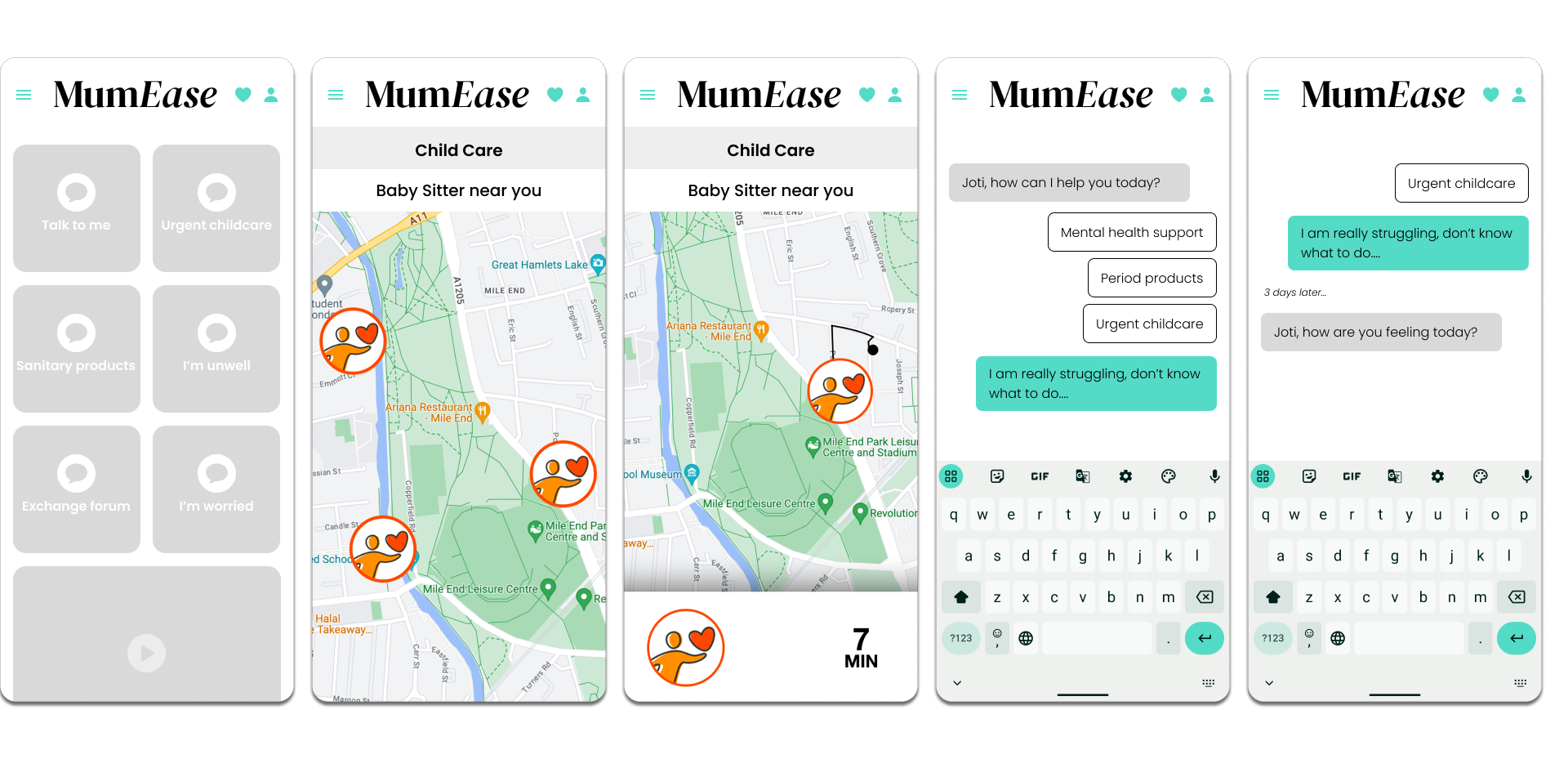
Team high-fidelity wireframes.
We built the initial screens in Figma during the hackathon, prioritising MVP features. Intentionally focused, enough to communicate the concept clearly within the time constraints.
Solo refinements.
After the design day, I returned to the MumEase UI independently to push the visual design further, deepen the user journey, and bring the product closer to something that felt real.
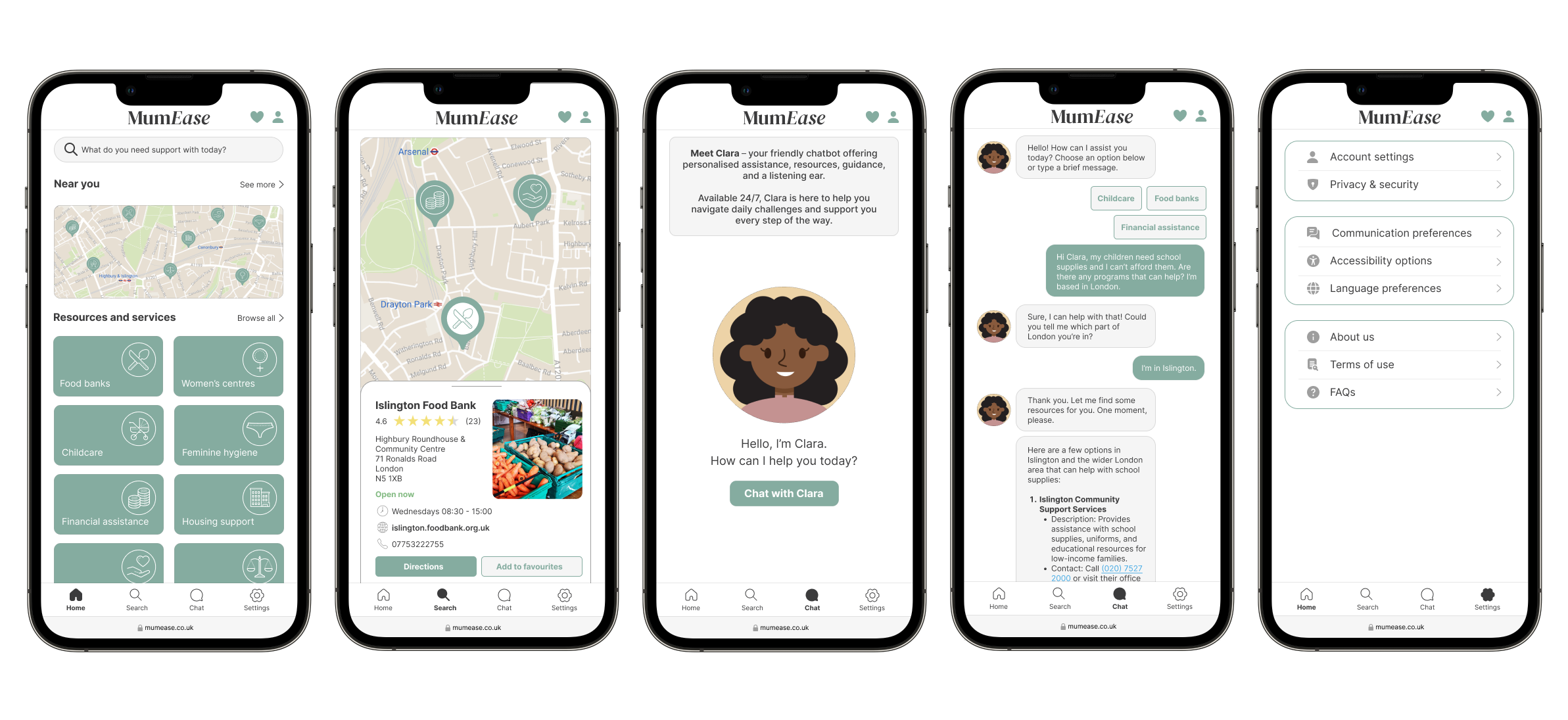
Searching for and navigating to local resources or services
Chatting with Clara, the chatbot, to receive personalised assistance
Next steps
Hauslabs is exploring the viability of the concepts that emerged from the design day. More details here.
Reflections
What I learned, and what I'd do differently.
Secondary research has a ceiling. The statistics grounded us, but they couldn't tell us how single mothers actually experience these systems day to day. Not speaking directly with users was the project's biggest limitation.
The hackathon format works, if the team does. Five people, one day, a meaningful outcome. Delegating to strengths and staying aligned made the difference. Crazy 8s helped too: forcing volume before quality is exactly what early ideation needs.
Designing for real-world constraints. Designing for users in poverty requires a different lens. It’s not just about usability, but accessibility in its broadest sense: low data, limited time, high stress, and inconsistent access to technology. If I took this further, I’d push even harder on offline functionality and low-friction interactions.
From concept to feasibility. The idea resonated, but we didn’t fully explore how it would work in practice. Keeping service information accurate, integrating real-time data, and ensuring reliability would all be critical to making MumEase genuinely useful. Given more time, I’d focus on the operational side of the product: how it functions beyond the MVP, not just how it looks and feels.

NoUrPC: Creating a digital service to improve young people’s perception of the police.
Thank you for reading! Click on a case study to view another 🚀
⇔
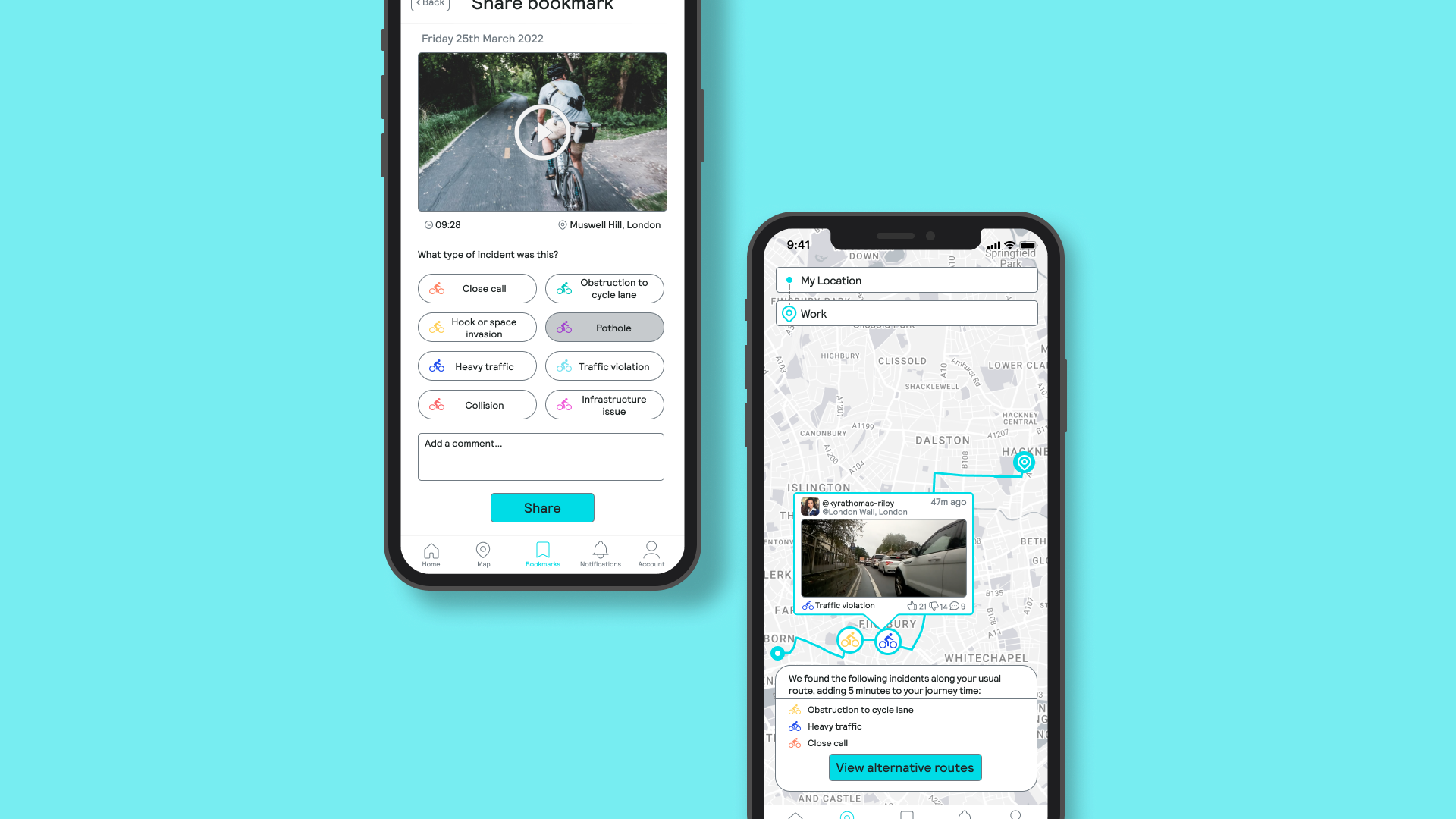
Onsee: An end-to-end design process for a safety and navigation focused cycling app.