
Overview
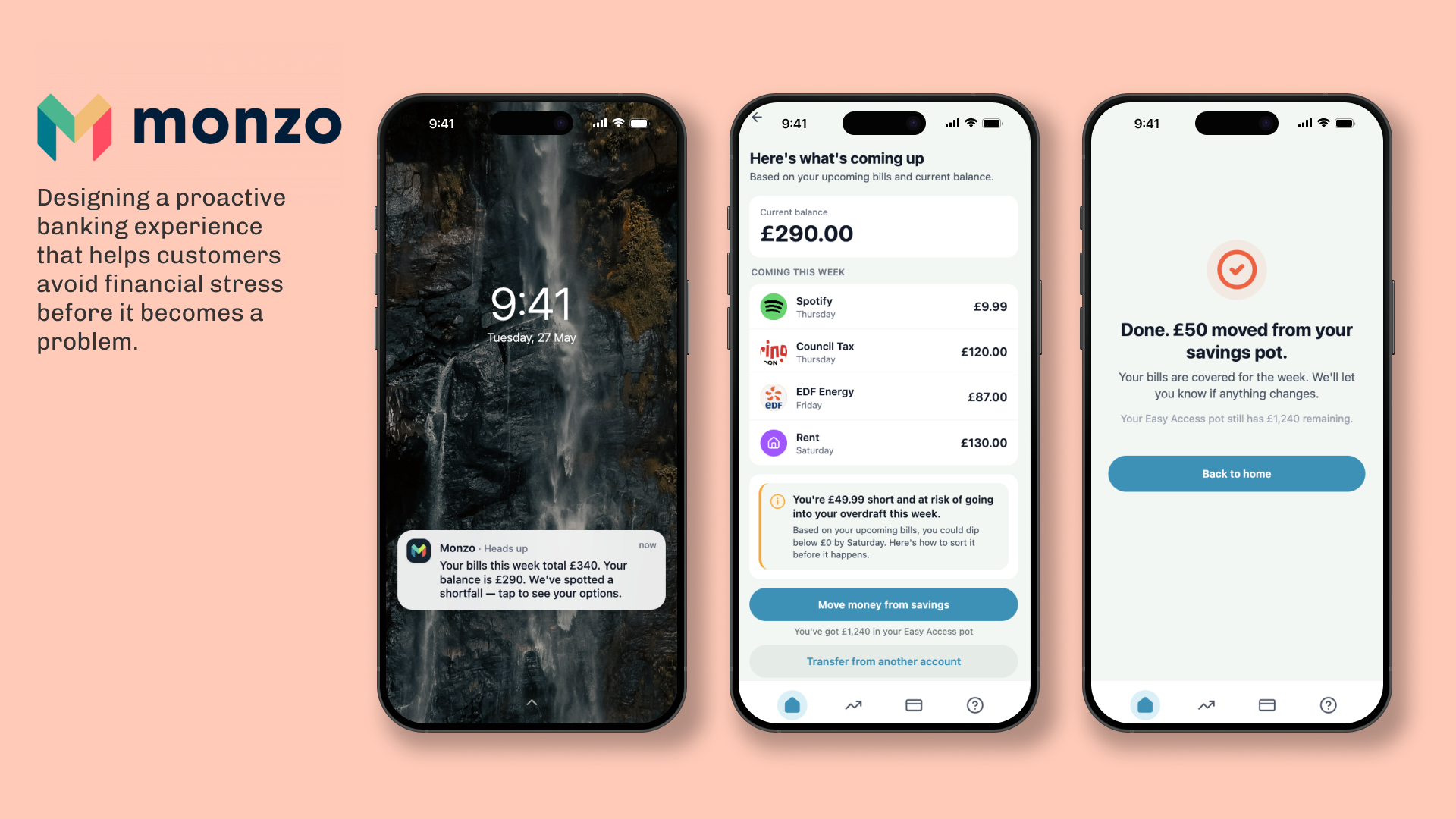
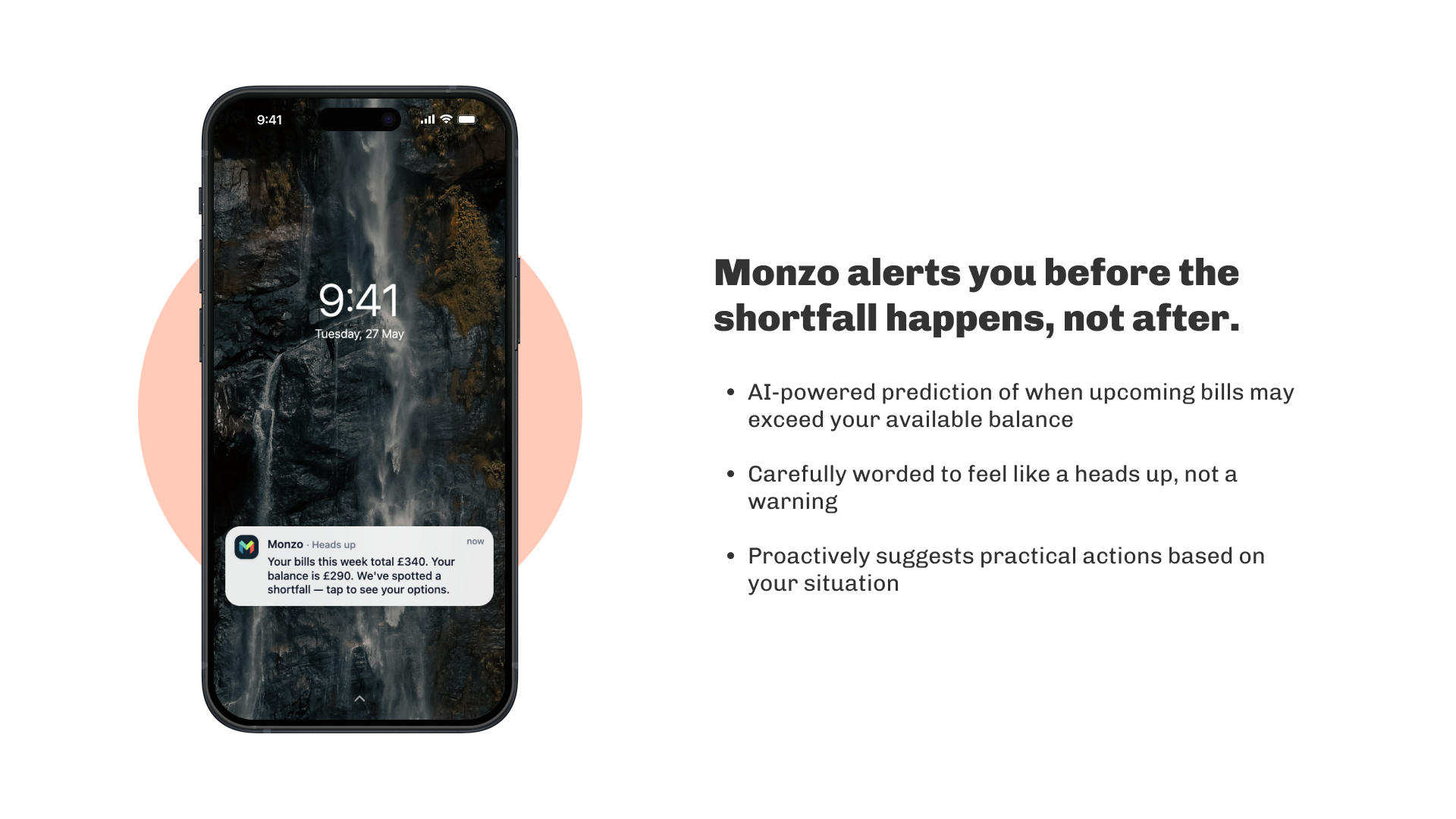
Monzo Money Intelligence is a proactive banking feature that identifies potential cash flow issues before they occur and offers practical actions to help customers stay in control.
Designed during the Experience Haus x Figma Make two-hour hackathon, this collaborative sprint explored how AI-first design could help banks anticipate customer needs rather than simply react to them, making retail banking feel more human.
Figma Make was used to generate and iterate the prototype in real time, allowing us to move from concept to interactive screens within the two-hour sprint.
My role
Product Designer, collaborating with two other designers across research, problem framing, prototyping and presentation
Methods
Secondary research · Problem framing · UX strategy · AI-assisted prototyping
Tools
Figma Make · Figma Slides · Claude · ChatGPT · Pen + paper
The problem
Banking apps are often designed to react after something has already gone wrong: a payment fails, an account goes overdrawn, or a bill is missed.
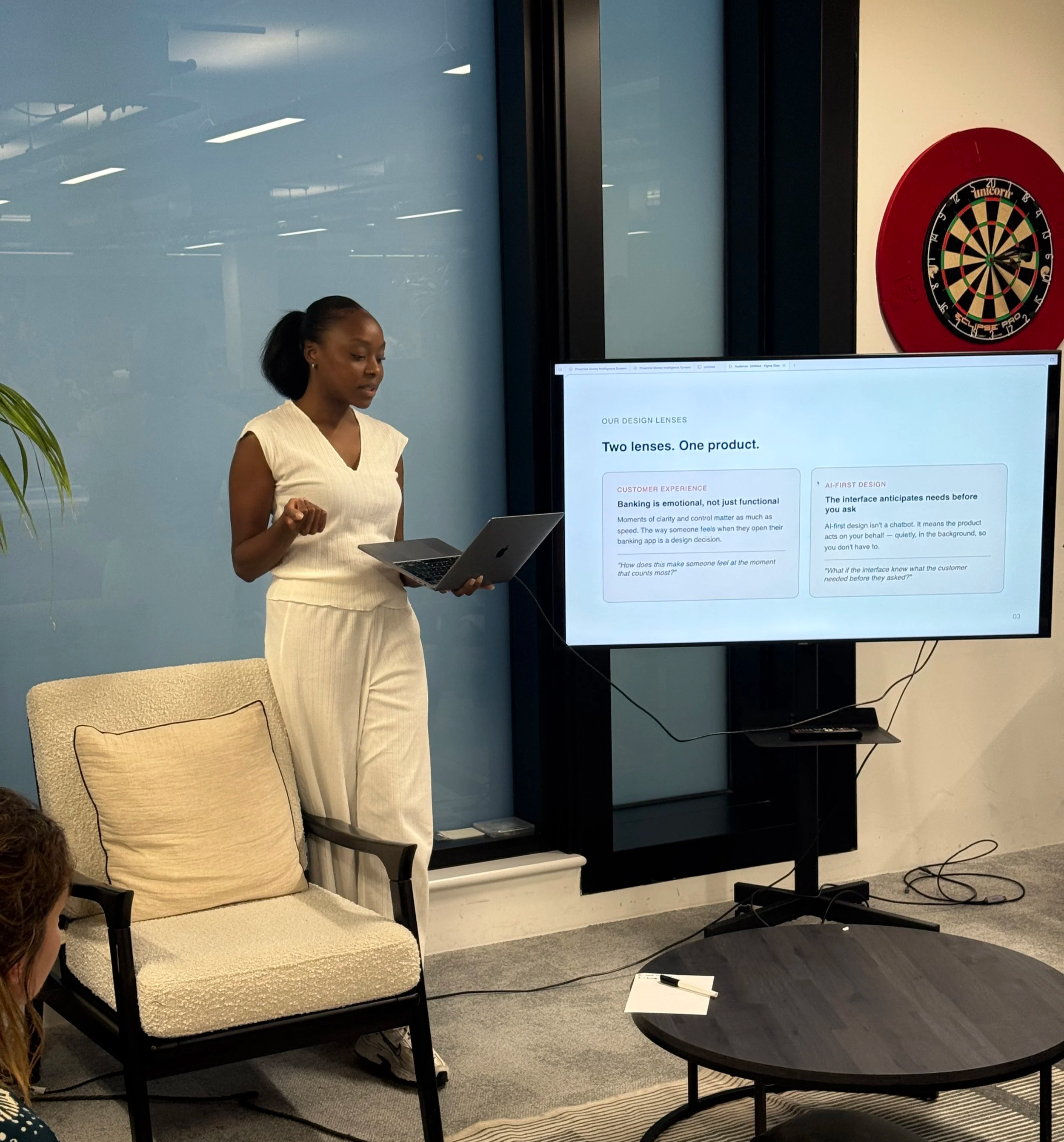
For customers managing multiple financial commitments, this reactive approach can contribute to stress and uncertainty, particularly among younger users.
The hackathon brief challenged us to design a retail banking experience that was “more human, more intelligent, or more empowering than what exists today.”
One question from the brief shaped our approach:
"What if the interface knew what the customer needed before they even asked?"
This shifted our thinking from reactive notifications towards proactive support. Rather than creating another tool, we explored how AI could be embedded within an existing experience to identify emerging financial challenges and support customers before they became problems.
THE SOLUTION
A proactive money intelligence feature that surfaces risks before they become problems.
SECONDARY RESEARCH
Customers want their bank to anticipate problems, not just respond to them.
of UK consumers feel anxious just opening their banking app.
GFT Banking Disruption Index, 2023
of 16 to 35-year-olds feel anxious opening their banking app — rising from the 77% national average.
GFT Banking Disruption Index, 2023
of UK consumers want their bank to warn them before things go wrong.
GFT Banking Disruption Index, 2023
of customers are completely surprised when they get hit with an overdraft charge.
CFPB Overdraft Report, 2024
Problem statement
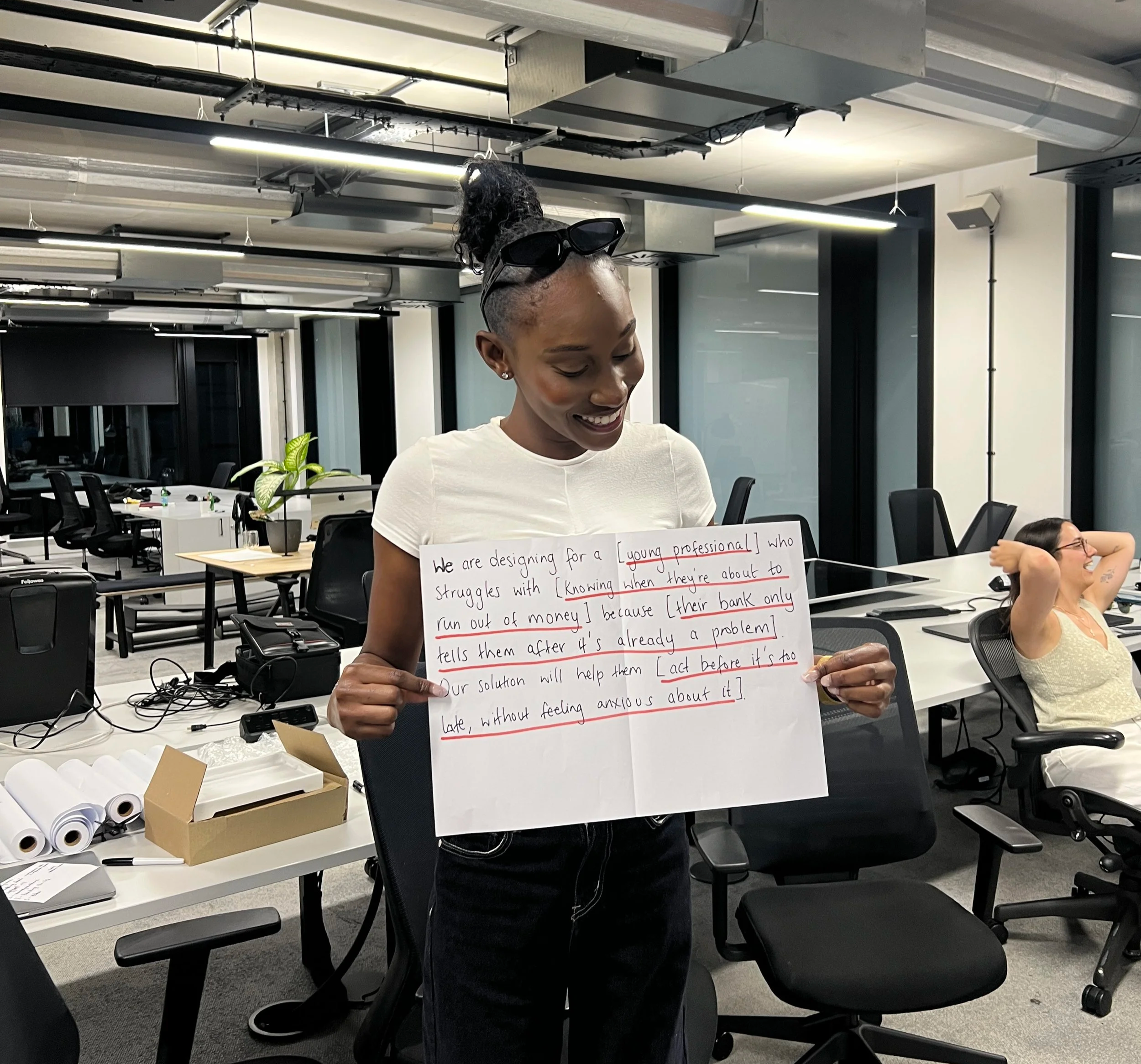
We are designing for a young professional who struggles with knowing when they’re about to run out of money, because their bank only tells them after it’s already a problem. Our solution will help them act before it’s too late, without feeling anxious about it.
USER JOURNEY
From reactive to proactive.
Mapping the end-to-end experience to understand how the user journey could evolve:
Current state
Future state
Design DEcisions
Designing for clarity rather than alarm.
The biggest design challenge wasn't the feature itself, it was the tone. Financial alerts can easily create anxiety if framed negatively rather than supportively.
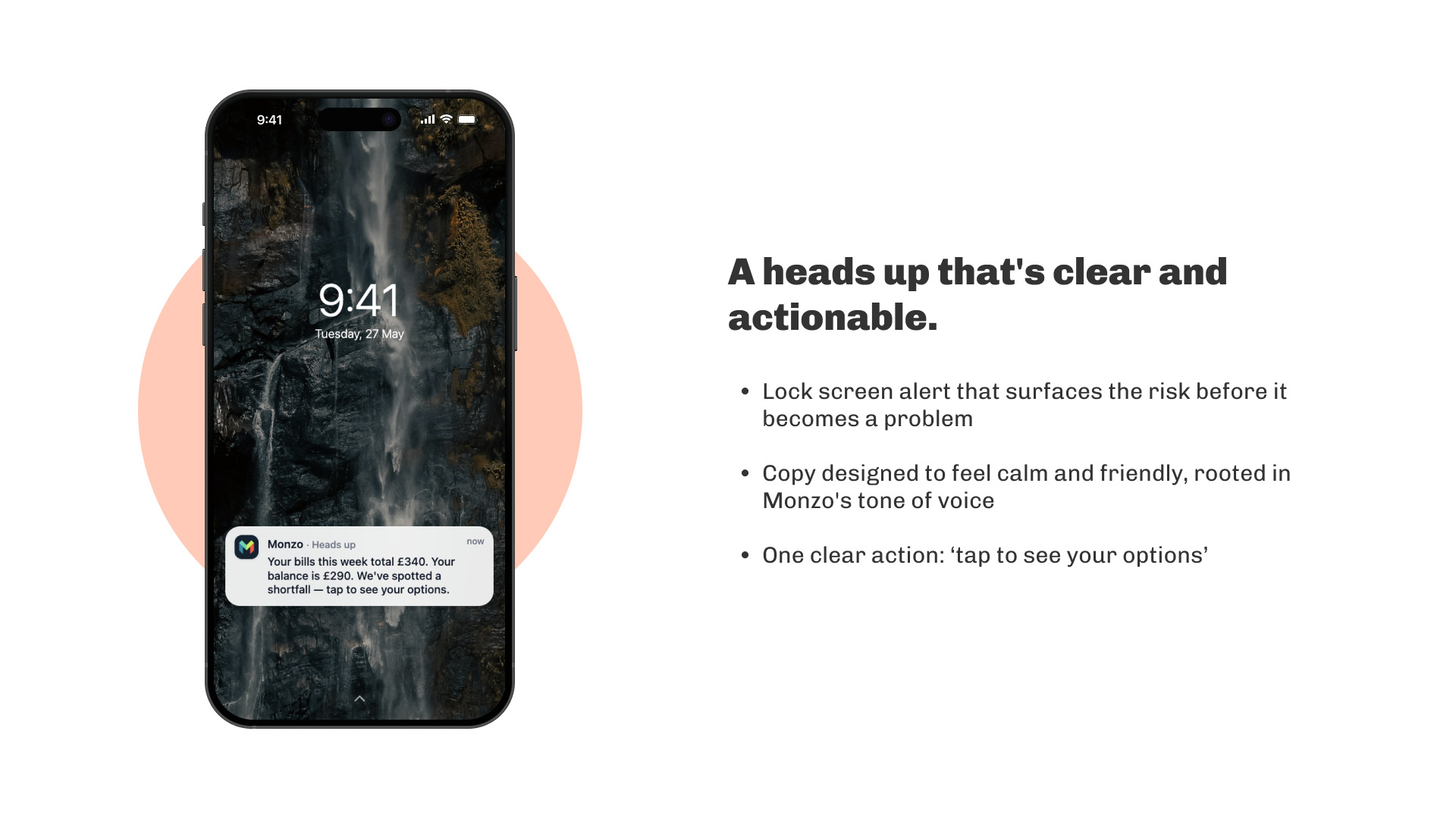
We rooted the language in Monzo's tone of voice: warm, direct, and never clinical. Our design principles reflected this:
| Principle | In practice |
|---|---|
| Reduce stress | Risk surfaced early, framed as a heads up not an alarm |
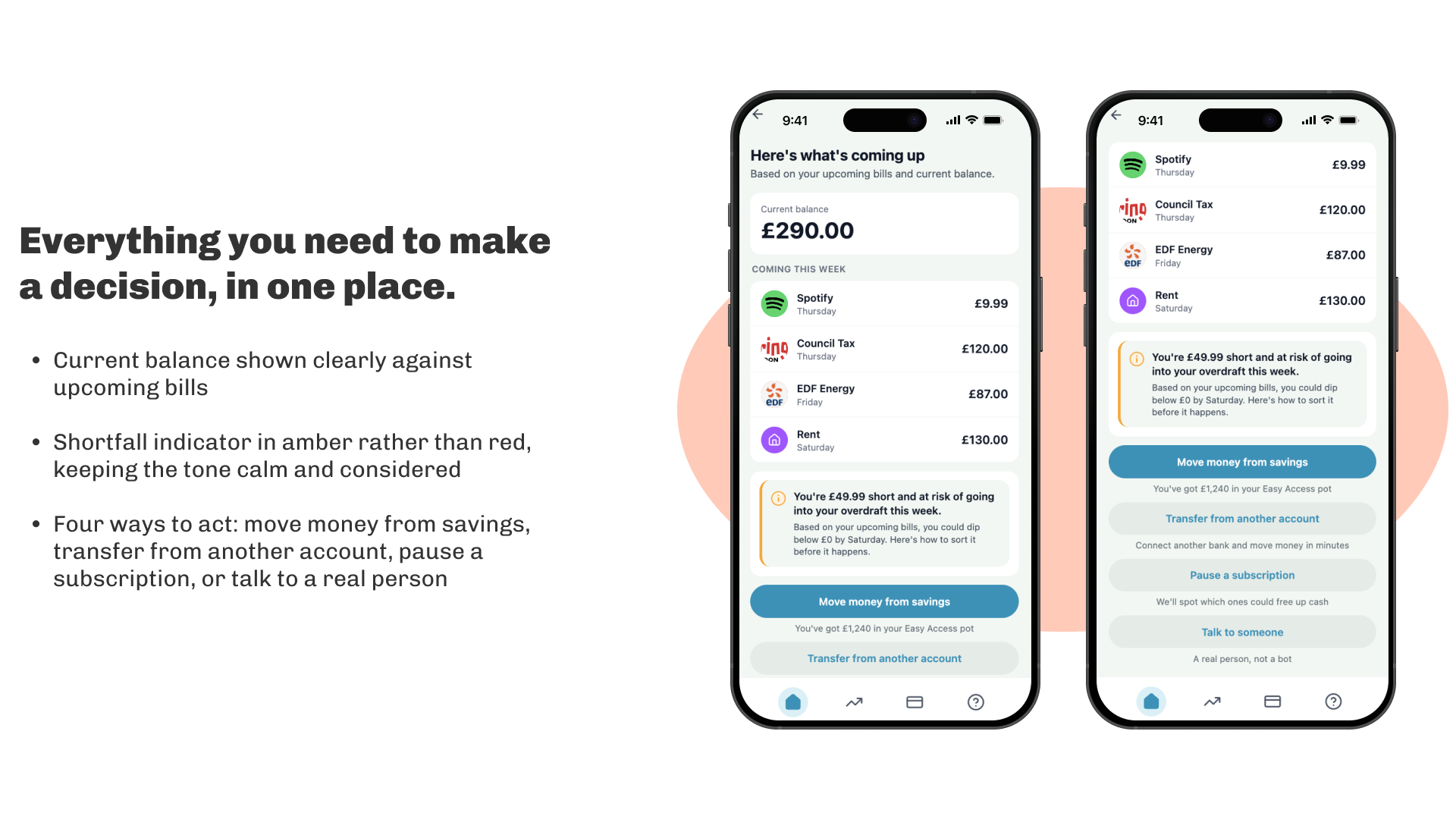
| Create clarity | Bills, balance and shortfall shown together in plain language |
| Support action | Every screen ends with a realistic, concrete next step |
| Feel human | Warm, approachable copy rooted in Monzo's tone of voice |
Final designs
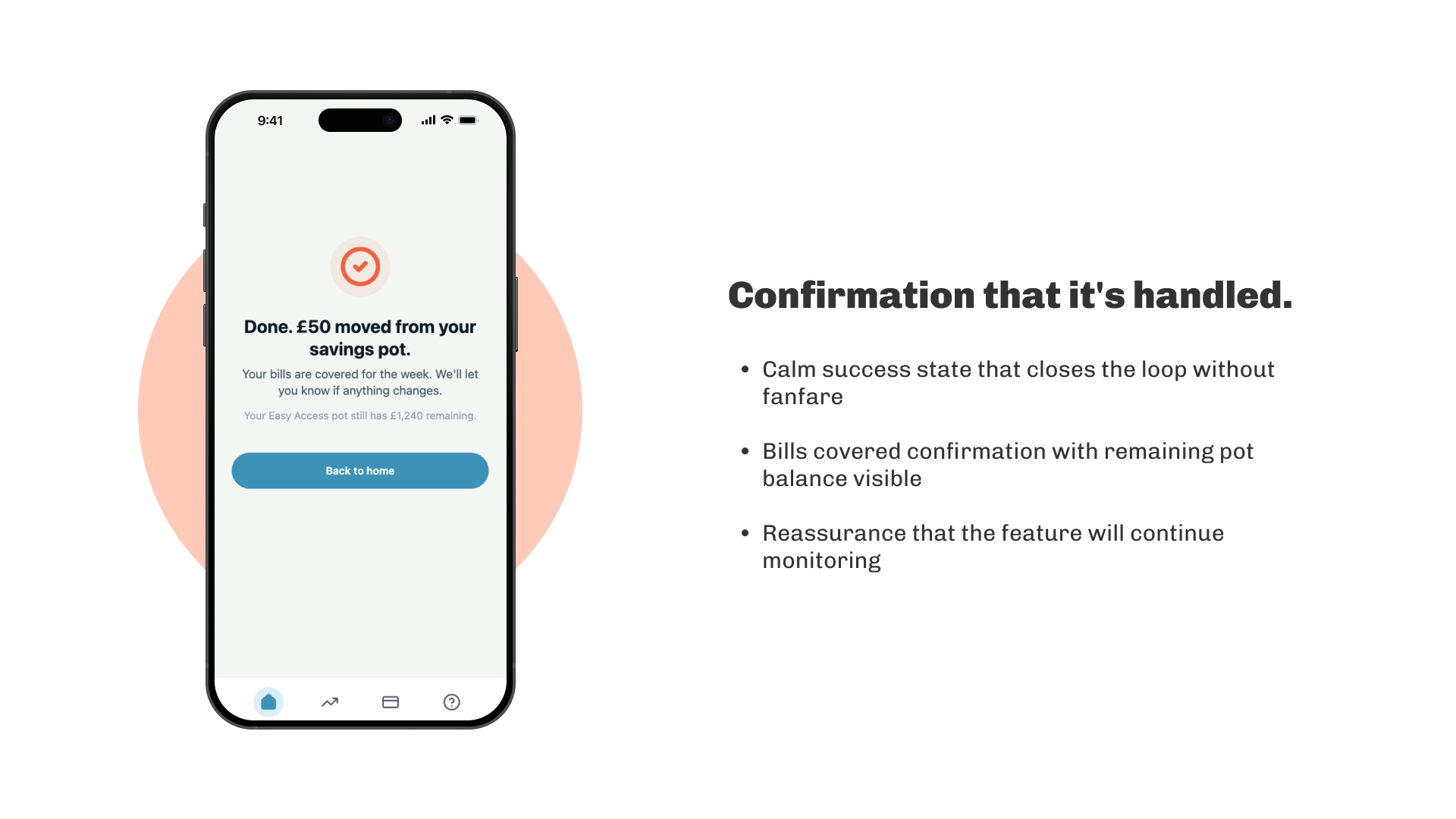
Three screens. One moment. Designed to feel calm and considered.
All three screens were built and iterated in Figma Make, with prompts refined in real time as the design evolved.
PROTOTYPE
The flow, from notification through to confirmation.
EARLY feedback
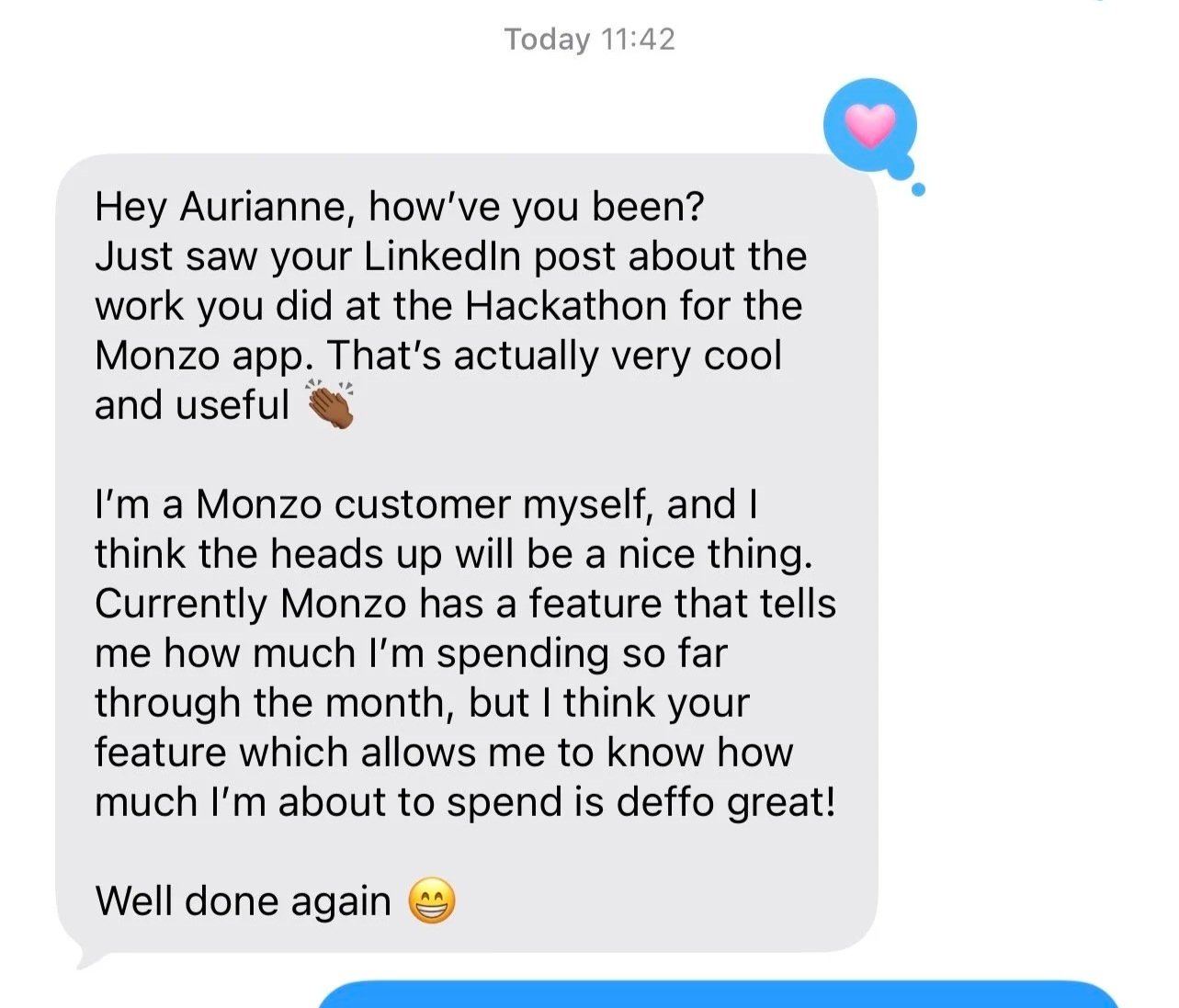
After sharing the concept on LinkedIn, a friend who uses Monzo messaged me saying they could immediately picture themselves using the feature.
“Your feature which allows me to know how much I’m about to spend is great!”
It was encouraging to see them articulate the core value of the feature in their own words: the distinction between knowing what you've spent and knowing what you're about to spend. A strong early signal that the problem is real and the concept is legible.
Reflections
What I learned, and what I'd do differently.
Financial products are emotional products. The most valuable insight from this project was recognising how closely financial wellbeing and emotional wellbeing are connected. Good banking experiences don't just provide information. They reduce uncertainty and help people feel more in control.
Designing for trust requires transparency. If AI is making recommendations about someone's money, users need to understand why. Transparency became just as important as accuracy.
AI tools change what's possible under constraint. Using Figma Make meant design decisions and prototypes evolved simultaneously rather than sequentially. It fundamentally changed how we worked under tight time constraints.
I'd validate the concept with customers. Given more time, I would test the experience with real users and explore how the feature could expand to incorporate salary awareness and open banking data from other accounts.
Onsee: An end-to-end design process for a safety and navigation focused cycling app.
Thank you for reading! Click on a case study to view another 🚀
⇔
MumEase: Innovating a digital solution that supports single mothers living in poverty.